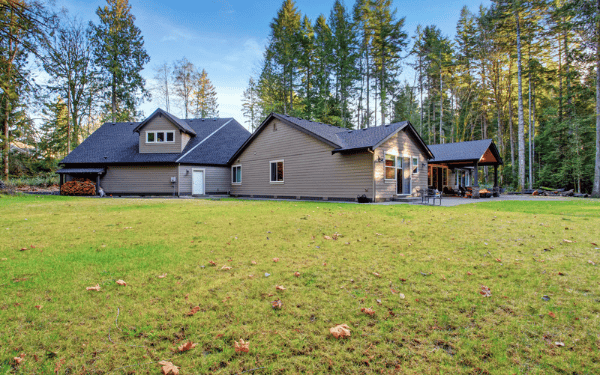
Can You Use a USDA Loan for a Home With Acreage in Northern Wisconsin?
Northern Wisconsin Lifestyle Properties November 13, 2026
Northern Wisconsin Lifestyle Properties November 13, 2026
Yes. You can use a USDA guaranteed loan to buy a home with acreage in northern Wisconsin, often with no down payment. USDA doesn't set a maximum number of acres, but the land has to be typical for the area, the home must be your primary residence, and the acreage can't be used to produce income.
That's good news for anyone hoping to live the Northwoods lifestyle full time, whether that's a home on 40 wooded acres near Park Falls or a place on the edge of the Chequamegon National Forest. Below, we break down how USDA financing works on rural property, what can disqualify a listing, and the Wisconsin-specific checks to plan for before you make an offer, including Managed Forest Law land.
A USDA guaranteed loan is a 30-year fixed-rate mortgage made by a private, USDA-approved lender and backed by USDA Rural Development. Because the federal government guarantees the loan, eligible buyers can finance the full purchase price with no down payment.
The guaranteed program is designed for moderate-income households buying a modest primary home in an eligible rural area. It's separate from USDA's direct loan, which serves lower-income buyers and is made by USDA itself.
You still qualify through your lender on credit, income and debt. USDA doesn't set a minimum credit score, but many lenders look for a score of about 640 or higher.
Much of the Northwoods fits USDA's rural profile, but eligibility is decided address by address. USDA generally considers communities with fewer than 35,000 residents that are rural in character and outside large metro areas.
Park Falls, Phillips, Butternut, Glidden and Mellen all have that small-town character, as do the communities around Hayward, Minocqua and Mercer. Buyers looking across Price, Ashland, Sawyer and Iron counties will find plenty of addresses worth checking.
To check a specific property, enter its address on USDA's Income and Property Eligibility website (eligibility.sc.egov.usda.gov). The map shows whether an address is eligible, ineligible or can't be determined, and it changes over time, so check every home you're serious about and have your lender confirm it.
There is no set acreage limit. USDA's lender handbook says there's no specific limitation on the size of the site. Instead, the land must be typical for the area, and the appraiser has to explain how the property compares with similar homes nearby.
In the Northwoods, homes on 10, 20 or 40 acres of woods are common, so there are often comparable sales to support them. Trouble usually starts when a home sits on far more land than the properties around it, such as a house on 160 acres of timber, and the appraiser can't find comparable sales.
The property also has to be mainly residential and hold only one home. A detached garage, pole shed or workshop is fine as long as it isn't used to produce income. If a listing carries a lot of extra land, ask your lender to review it before you make an offer.
Your household income can't exceed 115% of the area's median income. USDA released its 2026 limits on July 13, 2026, and they're set by county and household size, so Price County's limit can differ from Sawyer or Ashland County's.
USDA looks at household income, which counts every adult earning income in the home, even someone who won't be on the loan. Certain deductions, such as an allowance for each child and childcare costs, can lower the number that's compared to the limit.
The home must also be your primary residence. A USDA loan can't be used for a weekend cabin, a deer camp or a lake rental. To check your numbers, use the Income Eligibility tool on USDA's eligibility website or ask a USDA-approved lender to run them for you.
Most USDA problems on rural property come from how the land is used, not how much of it there is. Watch for these:
One helpful detail: a windmill, billboard or cell tower on the property doesn't automatically make the site income-producing under USDA's guidelines.
Most homes with acreage in the Northwoods run on a private well and a septic system, which Wisconsin calls a POWTS. USDA has standards for both. Plan for these checks:
Rural appraisals can also take a little longer, because appraisers have to find comparable homes with similar land. A local agent who knows recent Northwoods sales can help set realistic expectations.
USDA loans don't carry private mortgage insurance. Instead, they have a guarantee fee in two parts. For fiscal year 2027, which runs October 1, 2026, through September 30, 2027, USDA set the upfront fee at 1% and the annual fee at 0.35% for purchases and refinances.
The upfront fee can be rolled into the loan, so it doesn't have to come out of pocket at closing. The annual fee is figured on your remaining balance and paid monthly with your mortgage.
On a $250,000 loan, that works out to a $2,500 upfront fee and about $875 in the first year, or roughly $73 a month. You'll still have normal closing costs, homeowners insurance, property taxes and inspections.
For eligible buyers, USDA usually offers the lowest upfront cost. When a property or household doesn't fit, other loans can step in.
Loan type | Minimum down payment | Mortgage insurance or fees | Best fit for acreage buyers |
|---|---|---|---|
USDA guaranteed | 0% | 1% upfront, 0.35% annual | Primary home on land typical for the area, within income limits |
FHA | 3.5% | 1.75% upfront, 0.55% annual | Buyers over USDA's income limit or outside eligible areas |
VA | 0% for eligible veterans | One-time funding fee, no annual fee | Veterans and service members |
Conventional | 3% | Monthly PMI under 20% down, removable at 20% equity | Strong credit, larger down payment, second homes and cabins |
Farm Credit or local bank | Varies | Varies | Larger acreage, timberland or other income-producing land |
Farm Credit lenders and local banks often finance the home and acreage together in one loan, which helps when a property is too large or carries too much timber value for USDA.
Buying a home with land takes more than finding the right listing, and that's how we work: beyond the listing. We live the Northwoods lifestyle ourselves, and our office is right here in Park Falls. Matt is also a consulting forester, so when a property comes with an MFL plan or a stand of timber, we can walk you through what it means for your purchase and your loan. We'll help you spot listings that are a good fit for USDA financing, flag septic, acreage or road questions early, and connect you with local lenders who understand rural property.
If you're ready to trade the city for a few acres of woods and a quiet road home, give us a call. We'd love to help you find your place up north.
Matt & Brittany Schultz
United Country Real Estate | Northern Wisconsin Lifestyle Properties
715-518-9041
This article is general information, not lending advice. USDA rules, fees and income limits change, so confirm the details with a USDA-approved lender.
No. USDA has no specific acreage limit. The land must be typical for the area and can't be used to produce income.
Park Falls has the small-town profile USDA serves, but eligibility is confirmed by address. Check the property on USDA's eligibility website or ask your lender.
Possibly, but ask your lender first. MFL land must be managed for timber production, and a lender may view scheduled timber sales as income from the land.
The new owner must file a transfer form with the Wisconsin DNR within 30 days of the purchase or withdraw the land from the program.
It can be a problem. USDA expects a road that emergency vehicles and typical cars can travel at all times, so raise winter access with your lender early.
Yes, as long as those buildings aren't used to produce income. USDA allows non-residential buildings like a garage on the property.
Only if it will be your primary residence and the address is in an eligible area. A weekend cabin doesn't qualify.
There's no set maximum loan amount. How much you can borrow depends on your income, debts and the area's income limit.
USDA doesn't set a minimum, but many lenders look for a score around 640 or higher.
Stay up to date on the latest real estate trends.
Wisconsin USDA Loans
Wisconsin Land Maintenance
Wisconsin Hunting Land Value

Wisconsin Property Taxes

Wisconsin Land
Elevate your property selling journey by working with Matt & Brittany Schultz, bringing decades of hands-on land, waterfront, and financing experience to help you maximize your property's value.
United Country Real Estate
1133 4th Ave S, PO Box 434 Park Falls, WI 54552